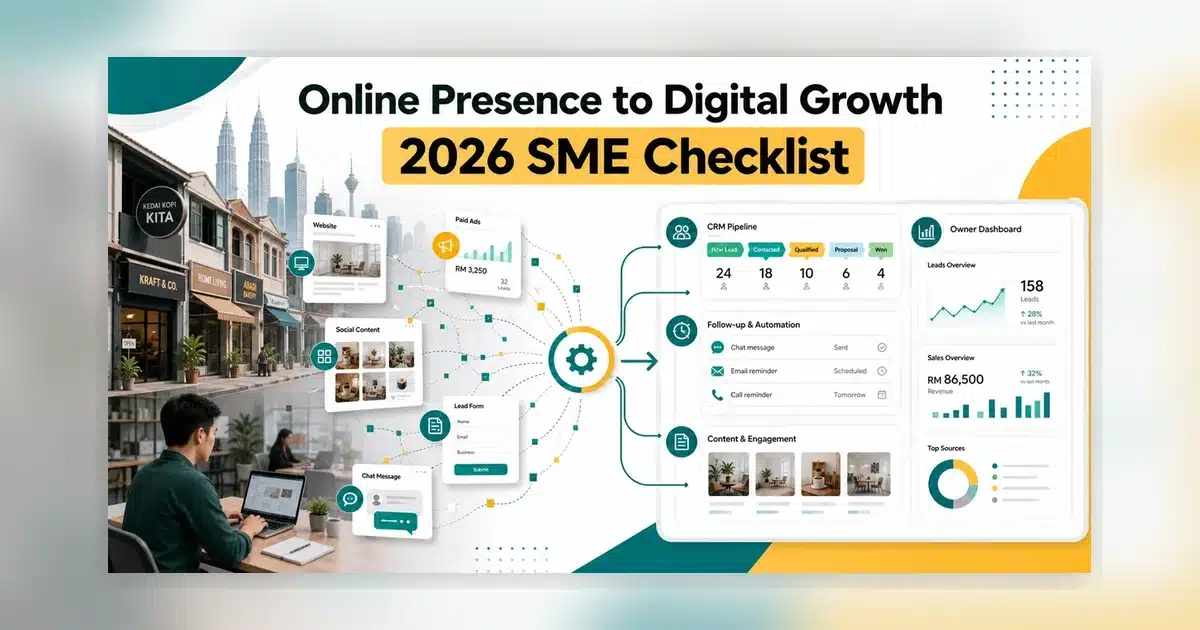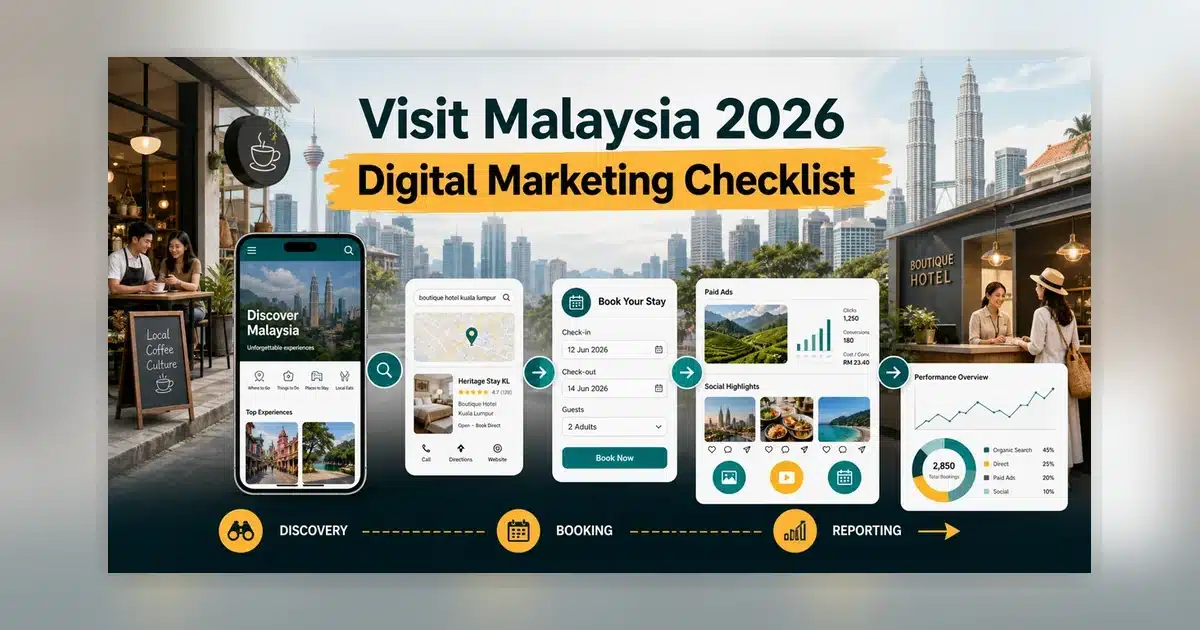
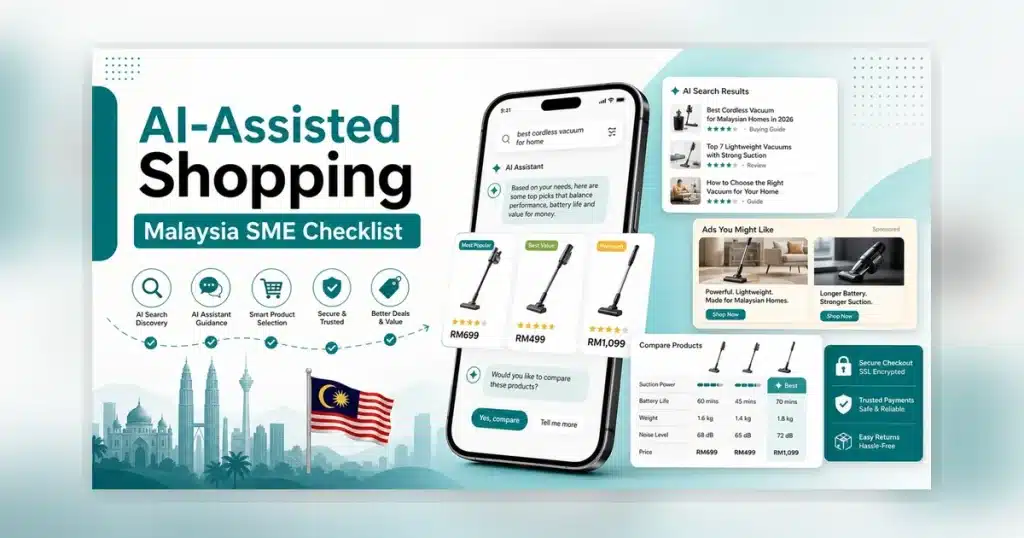
Malaysian customers are no longer only searching, clicking, and comparing by themselves. They are increasingly asking AI tools to narrow choices, explain differences, summarize reviews, compare prices, and decide which business is worth contacting. For SMEs, this changes the job of a website and ad campaign: the business must be clear enough for both humans and AI-assisted discovery.
The shift is already visible. Adyen’s 2026 Malaysia Retail Report says 74% of Malaysians use AI while shopping, while 52% are still uncomfortable letting AI complete purchases on their behalf. That combination matters: people may use AI for discovery and comparison, but trust, payment confidence, website clarity, and follow-up still decide whether they buy.
Why AI-Assisted Shopping Changes the SME Customer Journey
Malaysia is already a highly connected market. DOSM’s 2025 ICT survey reported individual internet usage at 98.3% in 2025, and DataReportal’s Digital 2026 Malaysia report estimated 35.4 million internet users and 30.7 million social media user identities. The practical takeaway is simple: customers have plenty of digital access, but their attention is fragmented across search, social, marketplaces, reviews, messaging apps, and AI interfaces.
AI-assisted shopping compresses that journey. Instead of opening many tabs, a customer can ask for recommendations, compare options, and refine a shortlist in one conversation. OpenAI’s product discovery update describes richer shopping experiences where users can browse visually, compare options side by side, and receive up-to-date product details. SMEs should treat this as a signal that product information, service pages, reviews, pricing context, and delivery details need to be easier to parse.
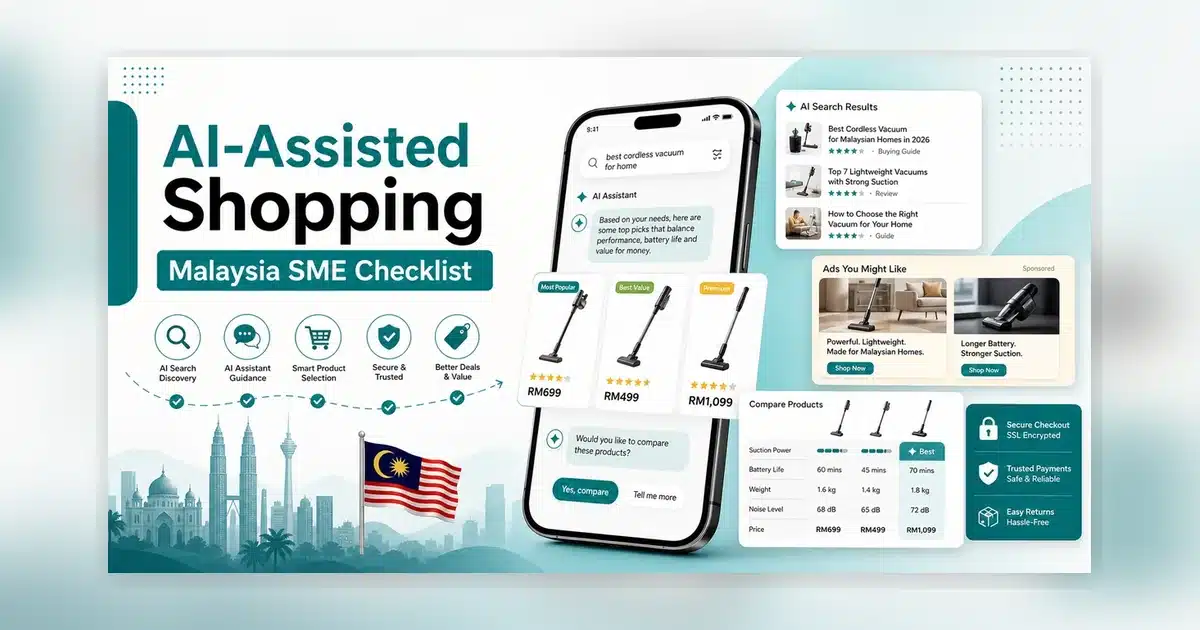
What AI Tools Need From Your Website
AI tools do not replace the need for a strong website. They increase the penalty for unclear websites. If a page hides key information, uses vague service descriptions, lacks comparison details, or has weak proof, the customer may never reach the enquiry form because the AI-assisted shortlist already moved on.
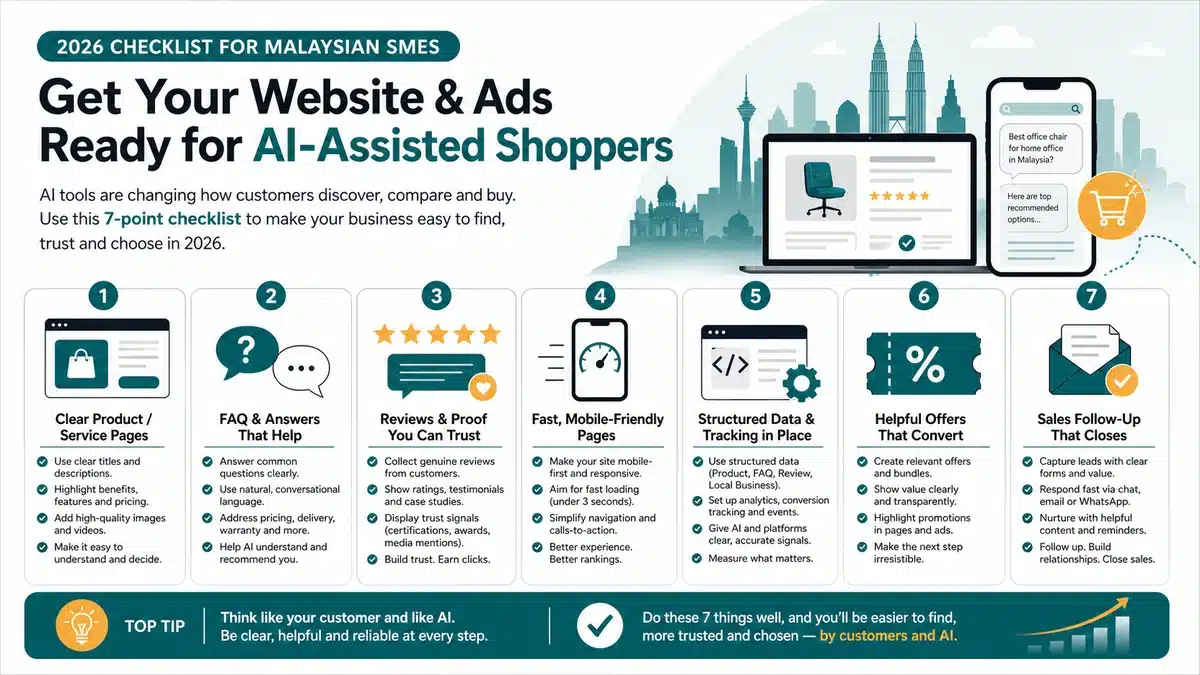
- Clear product or service pages: Put the offer, target customer, benefits, price context, deliverables, and next step in plain language.
- Helpful FAQs: Answer the questions a buyer would ask before contacting sales, including suitability, pricing factors, lead time, warranty, delivery, or support.
- Proof and trust signals: Add real reviews, project examples, certifications, partner badges, guarantees, payment security, and return or support policies where relevant.
- Strong mobile experience: Keep pages fast, readable, and easy to act on because many Malaysian buyers move between social, messaging apps, search, and mobile websites.
Atas Media Marketing’s website design services are relevant here because AI-assisted discovery still needs a destination that can explain the offer, capture demand, and support measurement. The stronger the landing page, the easier it is for ads, organic content, AI tools, and sales follow-up to work together.
How Search Ads Are Moving Toward AI-Led Answers
Search advertising is also changing. Google says it is testing ads in AI Mode that appear inside AI-generated responses while staying clearly labeled. Google has also described new Search ad formats built with Gemini that are designed to help brands answer more complex, decision-stage questions. The message for SMEs is not to chase every beta feature. The message is to prepare better inputs: useful pages, accurate feeds, strong creative, clear offers, and conversion tracking that identifies real business outcomes.
This is where campaign structure matters. Atas Media Marketing’s online advertising service supports Google Ads and Meta Ads campaigns, but AI-led advertising will only be as useful as the website, product information, audience signals, and sales feedback behind it. A campaign can bring attention; the business still needs to prove why it is the right choice.
The 7-Point AI Shopping Readiness Checklist
The best starting point is a practical audit. SMEs do not need to rebuild everything at once. They need to remove the gaps that make it hard for customers, ad systems, and AI tools to understand the business.
- Offer clarity: Can a buyer understand what you sell, who it is for, and why it is different within a few seconds?
- Comparison content: Do your pages help people compare options, packages, models, service levels, timelines, or use cases?
- Trust proof: Are reviews, testimonials, case examples, partner badges, awards, warranties, or guarantees easy to find?
- FAQ coverage: Do you answer objections before the customer needs to ask sales?
- Tracking quality: Are enquiries, calls, WhatsApp clicks, purchases, and qualified leads separated from softer actions like page views?
- Follow-up speed: Does the sales team respond quickly with helpful context, not just a generic reply?
- Creative consistency: Do ads, social content, landing pages, and sales messages tell the same story?
Social Content Still Shapes AI-Assisted Decisions
AI-assisted shopping does not make social content less important. It makes useful social content more important. Many customers first discover a product, service, or brand through TikTok, Instagram, Facebook, LinkedIn, YouTube, or creator content, then use AI or search to validate what they found.
That means social posts should do more than announce promotions. They should explain use cases, answer objections, show proof, compare scenarios, and build familiarity before a customer starts asking AI tools what to choose. Atas Media Marketing’s social media marketing service connects naturally to this shift because social content gives customers and campaigns more reasons to trust the brand before the enquiry happens.
Do Not Ignore Trust, Security, and Transparency
The trust gap is the central point. The same Adyen Malaysia research found that many shoppers use AI but remain cautious about AI completing purchases. Google is also expanding AI transparency in ads so people can better understand when generative AI was used in ad creation. SMEs should take the hint: customers need clarity, not just automation.
Practical trust signals include secure checkout pages, clear contact details, accurate business information, transparent pricing or quote logic, genuine reviews, visible return or cancellation terms where relevant, and a human follow-up path for customers who are not ready to buy through automation.
FAQs
What is AI-assisted shopping?
AI-assisted shopping is when customers use AI tools to discover, compare, shortlist, or evaluate products and services before buying or contacting a business.
Does this only matter for ecommerce stores?
No. Service businesses also need clear pages, proof, FAQs, pricing context, and enquiry paths because buyers can use AI to compare agencies, clinics, contractors, education providers, and B2B suppliers.
How can SMEs appear better in AI-assisted discovery?
Start with clear website content, helpful FAQs, product or service details, reviews, consistent business information, and pages that answer real buyer questions in plain language.
Should SMEs change their Google Ads strategy because of AI?
They should improve the inputs first: landing pages, conversion tracking, creative assets, audience signals, and sales feedback. AI-led ad tools perform better when the business gives them clearer information.
What is the biggest mistake SMEs make with AI shopping readiness?
The biggest mistake is assuming AI visibility is only a technical SEO issue. It is also a content, trust, offer, tracking, and follow-up issue.
How often should a business review its website for AI-assisted shoppers?
A practical cadence is quarterly for core pages and monthly for active campaign landing pages, especially when offers, product availability, pricing, or customer objections change.
Make Your Business Easier to Find, Trust, and Choose
AI-assisted shopping will not remove the need for strong marketing fundamentals. It raises the standard. Malaysian SMEs need websites that explain clearly, ads that answer real buying intent, social content that builds trust, and tracking that shows which channels create real enquiries and sales.
If your business wants to prepare its website, ads, and customer journey for AI-assisted shoppers, contact Atas Media Marketing to review your current setup and plan the next improvement.