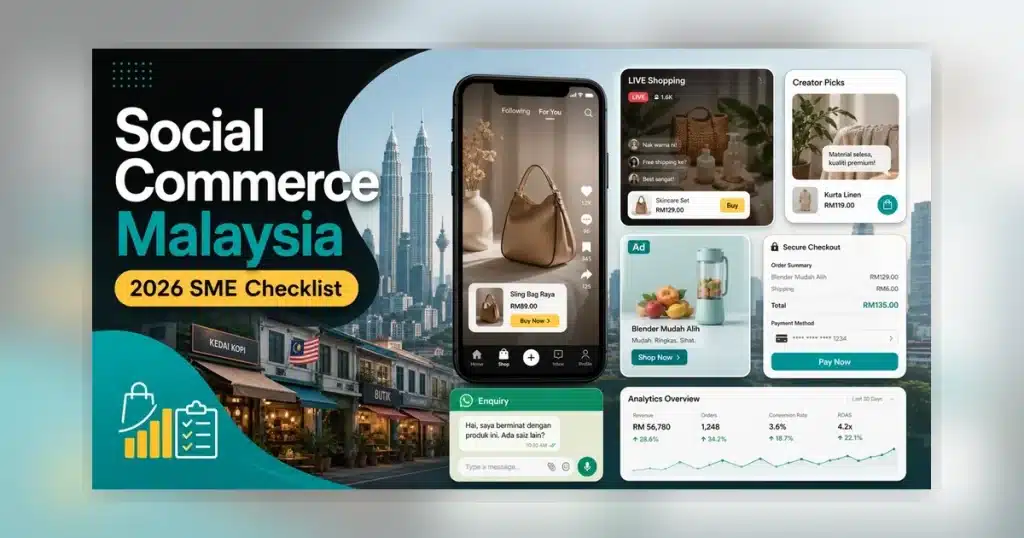
Social commerce is no longer just an experiment for Malaysian SMEs. Customers discover products in short videos, watch live selling sessions, tap product cards, ask questions in chat, compare offers, and decide whether to buy or enquire without following the old website-first path.
The timing matters because Malaysia’s social shopping ecosystem is becoming more commercially structured. TikTok’s Malaysia Socioeconomic Impact Report said TikTok contributed about RM20 billion in gross value added and supported 147,000 jobs through creators, sellers, businesses, TikTok Shop, and TikTok LIVE. For SMEs, the useful question is not whether social commerce is real. It is whether their content, ads, website, and follow-up are ready to turn attention into revenue.
Why Social Commerce Is a 2026 SME Priority
Malaysia gives SMEs a large reachable digital audience. DataReportal’s Digital 2026 Malaysia report estimated 35.4 million internet users and 30.7 million social media user identities in late 2025. It also reported that TikTok’s ad tools showed 30.7 million users aged 18 and above in Malaysia. The exact platform numbers need interpretation because advertising reach is not the same as active-user count, but the direction is clear: social platforms are a primary place where Malaysian customers spend attention.
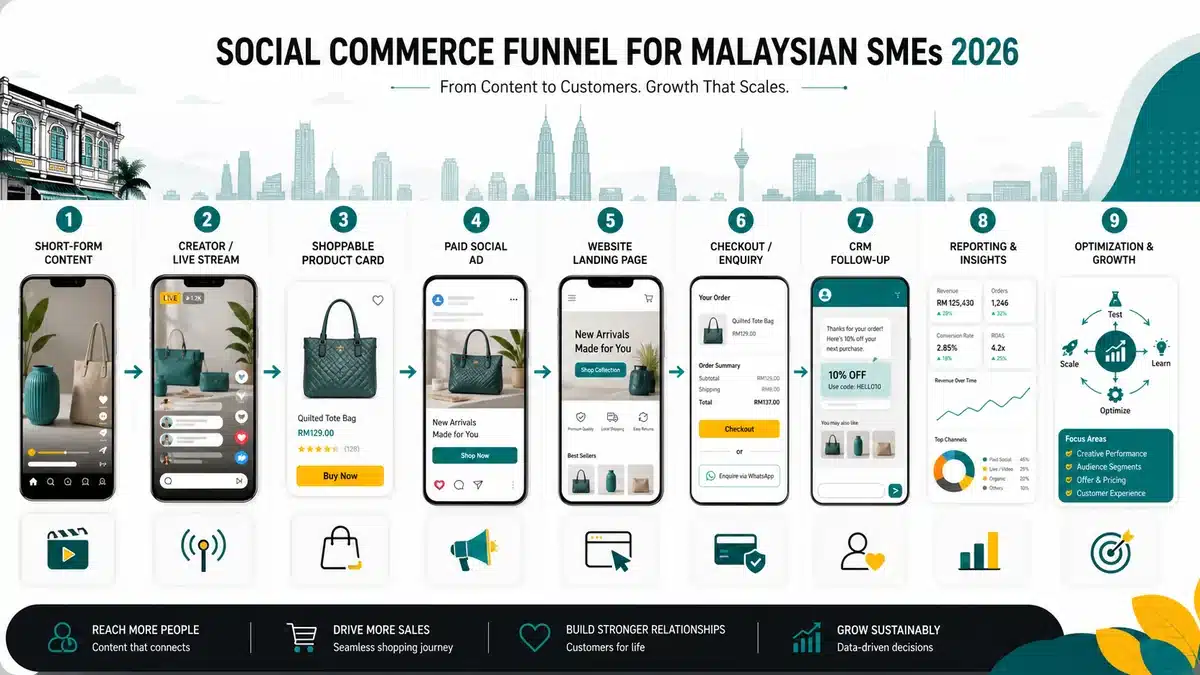
That changes how SMEs should plan campaigns. A customer may see a creator video first, watch a live demo later, click a shopping card, visit the brand’s website for proof, then ask a final question through chat. The funnel is not linear. It is a loop of content, proof, convenience, and follow-up.
What TikTok Shop and Showcase Mean for Marketing
TikTok describes TikTok Shop and Showcase as commerce tools that let sellers connect products to in-feed videos, livestreams, and profile Showcase tabs. That matters because product discovery, content, creator trust, and checkout can sit much closer together than in a traditional awareness campaign.
The opportunity is not limited to brands with a full ecommerce operation. Service businesses can still apply the same logic: show use cases, answer objections, collect enquiries, retarget engaged audiences, and move serious prospects into a sales follow-up process. The channel may be social, but the goal is still measurable demand.
The 2026 Social Commerce Checklist for SMEs
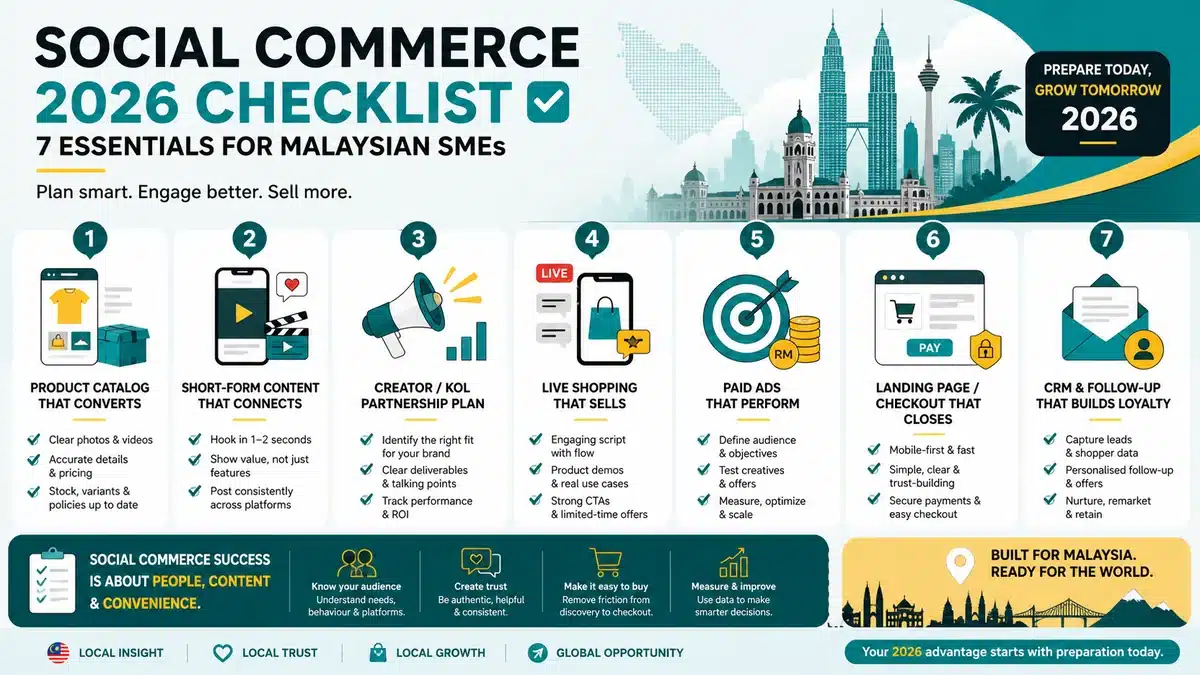
A practical social commerce setup should connect content, paid media, landing pages, checkout or enquiries, and sales follow-up. SMEs should audit these seven areas before increasing budget.
- Product catalog: Keep names, pricing, variations, stock, delivery, photos, and product claims accurate across shop, website, and ads.
- Short-form content: Lead with the problem, use case, transformation, demo, or comparison instead of only showing product features.
- Creator or KOL plan: Match creators to the audience, product category, tone, deliverables, usage rights, and measurable campaign objective.
- Live shopping script: Prepare product order, talking points, offer timing, proof points, objections, bundles, and a clear call to action.
- Paid ads: Test hooks, offers, audiences, creative formats, retargeting windows, and product or enquiry objectives separately.
- Landing page or checkout: Make the next step fast, mobile-friendly, trustworthy, and consistent with the content that drove the click.
- CRM follow-up: Capture leads cleanly, respond quickly, segment buyers, nurture abandoned enquiries, and report which campaigns create real sales.
Why Discounts Alone Are Not a Strategy
Recent platform activity shows how competitive the social-commerce market is becoming. TikTok Shop and KPDN’s June 2026 initiative included reduced commission fees for essential categories, nationwide shipping rebates, and discounts on daily necessities. TikTok said the initiative invested more than RM180 million directly into local communities. SMEs can benefit from marketplace momentum, but they still need their own differentiation.
If every campaign depends only on vouchers, margins weaken and customers learn to wait for discounts. Stronger social commerce uses offers as one part of the system: content creates demand, proof reduces risk, ads scale winners, landing pages answer questions, and follow-up converts undecided buyers.
How Atas Media Connects Social Content, Ads, and Conversion
Atas Media Marketing positions itself as a full-service digital agency across website design, online advertising, social media, and content creation. That mix is relevant for social commerce because a single weak area can break the funnel. Good content without a checkout or enquiry path wastes attention. Good ads without trust proof waste budget. A good website without retargeting and follow-up leaves revenue behind.
For SMEs, the priority is to make each channel reinforce the next one. Atas’s social media marketing service can support content planning and community engagement, while its online advertising service can scale tested creatives and retarget high-intent audiences. Its website design services help turn campaign traffic into a clearer buying or enquiry experience.
What to Measure Beyond Views and Likes
Social commerce teams need performance metrics that connect content to sales. Views and likes help diagnose attention, but they do not prove business value by themselves. SMEs should track hook rate, product-card clicks, add-to-cart actions, checkout completion, enquiries, WhatsApp starts, qualified leads, customer acquisition cost, repeat purchases, and revenue by creative theme.
The operating question should be specific: which creative angle attracts the right buyer, which offer closes, which audience retargets profitably, and which follow-up message recovers the most abandoned demand? That is the difference between posting content and running a social commerce system.
FAQs
What is social commerce?
Social commerce is the use of social platforms, creator content, live shopping, product tags, ads, chat, and checkout or enquiry flows to move customers from discovery to purchase.
Is TikTok Shop suitable for every SME?
No. It depends on the product, margins, fulfilment ability, content capability, customer support, and whether the business can compete on trust, proof, convenience, and offers.
Do service businesses need social commerce?
Service businesses may not need product checkout, but they can use the same social-commerce principles to generate enquiries through useful content, proof, ads, landing pages, chat, and follow-up.
Should SMEs use creators or run ads first?
Most SMEs should test content angles first, then use creators and ads to scale the messages that show demand. Ads work better when the creative already answers real buyer objections.
What is the biggest social commerce mistake?
The biggest mistake is treating social commerce as random posting. A proper setup connects catalog accuracy, content, ads, landing pages, checkout or enquiry, follow-up, and reporting.
How often should a business review social commerce performance?
Active campaigns should be reviewed weekly, while catalog accuracy, landing pages, creator performance, and follow-up quality should be audited at least monthly.
Build a Funnel That Turns Content Into Customers
Social commerce rewards SMEs that make buying easy and trustworthy. The winning setup is not one viral video. It is a connected system of product information, creator content, paid distribution, website or checkout clarity, fast follow-up, and performance reporting.
If your business wants a clearer social commerce plan for content, ads, landing pages, and follow-up, contact Atas Media Marketing to review your current funnel and plan the next improvement.